

The 5 Avoidable Mistakes 40+ Year Old Ex-Corporate Executives Make When Scaling Their One-Person Business.
Stop wasting money, time, and effort.

You’ve quit your job.
Congrats.
You can’t wait to get started as a solopreneur.
You start to put yourself out there and expect a line of customers, cash in hand, waiting to buy from you. So you do what you do best. You create a website, a logo, a mission statement, and start posting on LinkedIn.
Everything looks slick and polished.
When you launch, everyone messages you to congratulate you, but no one buys.
Not. One. Person.
You assume this is just a slow start.
But after a few months, nothing changes.
You start to feel stuck. No one is buying from you. Your confidence dips, your early motivation wears off, and now you’re feeling a growing sense of desperation. You feel anxious thinking about the future.
You feel utterly embarrassed and ashamed to tell anyone.
You have a mortgage and a family of three to care for. You’re now 3 months into your journey with only a few clients and no sales pipeline. You hear Karen from HR, who told you not to take the risk. Yikes.
The worst part?
This situation isn’t caused by just one mistake.
You’re in this position because of a series of small mistakes.
I know what it feels like to be here.
The good news?
I can help you get out of it.
Let’s get started.
You’re a technical expert, so why can’t you attract clients?
There’s a hidden tax ex-corporate employees pay when they become solopreneurs:
The Expertise-tax.
This is a tax you pay when you’re too good at your job.
I’m not joking. This exists.
The expertise tax is a real problem that many ex-corporate executives struggle with. I work with so many talented executives who struggle to overcome the curse of knowledge. Decades of experience, knowledge, and expertise can blind you to the basic problems your customers face.
But being a technical expert does not equal being an entrepreneur.
These are fundamentally different skills.
As an ex-corporate solopreneur, you need technical skills,
But you also need to:
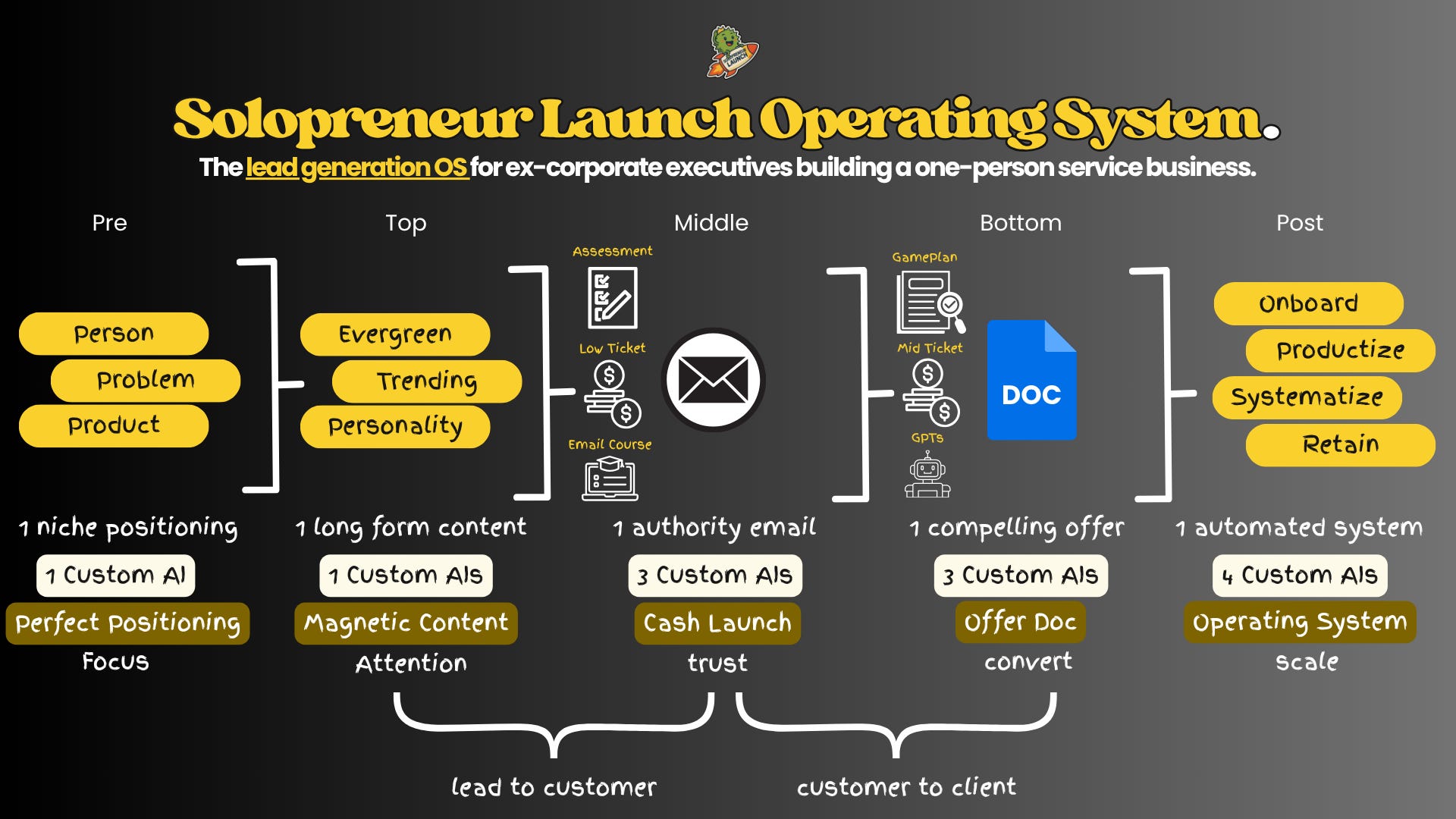
Understand your niche positioning.
Create high-value content that attracts your dream customer.
Build an email list that scales your expertise and authority.
Create a compelling offer that converts your leads
Build a delivery system that scales your impact.
This won’t happen overnight.
But this is a solvable problem.
Here’s how we can build this together:
Mistake #1: Why you’re being ignored by your dream customers.
James spent four months building a product that generated $0 in sales.
The mistake he made wasn’t product quality. He didn’t have a clear positioning. When I asked him who this product would be for, he stumbled over his words and blurted out what is effectively the kiss of death in entrepreneurship:
“This is for everyone.”
If you’re for everyone, you’re for no one.
This lack of specificity creates ambiguity.
And remember:
A confused mind does not buy.
If someone can’t look at your brand and definitely say, “This is for me,” you’re in trouble.
Clear is better than clever.
If you aim to be everything to everyone, you’ll become nothing to no one. Appealing to everyone makes your brand bland. You start to taste like water. No one knows what your values or philosophy stand for.
Think about IKEA.
IKEA is abundantly clear who their products are for. They are looking to attract cost-conscious consumers who want a no-frills experience when buying furniture for their new apartment or office space.
They are comfortable ignoring the rest of the market.
IKEA is NOT for:
Luxury furniture purchasers.
People who want a concierge experience of buying.
Want their furniture fully assembled instead of doing it themselves.
IKEA became something special to someone specific and is cherished by this group.
If your message isn’t specific, you’ll be ignored.
If the problem you’re solving isn’t clear, you’ll be ignored.
If the unique way you solve the problem isn’t compelling, you’ll be ignored.
Do anything but create clarity, and you’ll be ignored.
The lack of sales left James feeling frustrated.
He felt like the last four months had been wasted. All that time spent building without understanding the product's positioning.
But there was a solution.
In entrepreneurship, nothing is ever lost.
Even if a product launch bombs, you’re now starting from experience and data.
What did we do together?
Become ultra-specific on serving one person: We crafted a story of his ideal customer. More than just demographic data, we wanted to know the day-to-day reality, the story he told himself, and how he currently solves his problems. In order to attract a customer, we must become them (that’s Star Wars stuff right there).
Solve one painful problem: There are only 3 evergreen problems you can solve. This includes 1) wealth, 2) health, and 3) relationships. That’s it. Every other problem is a subset of one of these evergreen problems. We aligned his product to clearly solve one of these problems.
Create a solution at the right time that’s unique: We identified a specific transition point for when his ideal customer buys. This is usually death or divorce of a partner. He used his unique lived experience and knowledge to solve her customers’ problems.
For James, we worked together to become super-duper clear on all three components.
Remember:
If your brand doesn’t stand for something, you fall for anything.
Be so clear that your dream customers can’t ignore you.
Mistake #2: The reason your content sucks.
Devon built a large following.
He was well-known in the fitness industry for creating high-value educational content. This type of content performed well in the past. But with AI, people aren’t looking for more purely educational content anymore.
AI has generated an overabundance of educational content with a single prompt.
But AI doesn’t destroy value; it only shifts it elsewhere.
When educational content is everywhere, people start to crave other types of content. They need people to interpret current events and create more personality-driven content that fosters deeper connections.
Remember:
Connection is becoming rarer at the same time it is becoming more valuable.
Look at Elon Musk’s personal brand.
When you hear his name, it elicits a strong emotion.
You can’t help but feel something. Negative or positive. People have an opinion of you.
But Elon’s content is more than just the technical aspects of electric car manufacturing, reusable rockets, or underground roads. He posts memes, occasionally trolls people, and updates them on topics of interest to him.
Whether you hate or love it, you know who he is.
You understand what he stands for. There’s no ambiguity.
People buy the coach before they buy the coaching.
Education-only content is becoming a commodity. Information asymmetry is no longer a competitive edge. Consumers are demanding more personality in the content they consume. No matter how flawed.
Elon makes his audience feel anything BUT bored.
What did we do together?
Mixed content. We broke his content into 50% evergreen educational content, 25% trending topics, and 25% personality-driven content.
Embedded more personality quirks in his educational content to make it more unique and distinct from the results you would receive from ChatGPT.
Leveraged more origin stories that demonstrated vulnerability, connection, and emotion, which allows customers to connect rather than showing the highlight reel.
The mixture of content creates variation.
And like in relationships, variety is the spice of life (and content).
People buy the person before they buy the product.
Mistake #3: The hidden thing that will silently kill your business.
Sam’s business was 100% reliant on his large social media audience.
While impressive, this created systemic risk.
One change in the algorithm, preferences, or a ban would destroy his entire business model. He relied on social media for his leads, his brand, and for communicating with his customers and audience.
Remember:
If you don’t own your distribution, you don’t own the experience.
If you don’t own the experience, you don’t own the outcome.
If you don’t own the outcome, you don’t own your business.
If a social media company can crush your business, you don’t have a business.
Business happens at the speed of trust.
If you’re allowing a platform to curate the customer experience, your business is 100% reliant on that platform to treat them well. Any change in the algorithm, policy, or platform ownership could cause your customer base to evaporate overnight.
Imagine all that work. Gone. Overnight.
I worked with a client with over 23 million followers and millions of monthly views.
(Yes, million. Not a typo)
With these types of numbers, you’d think they would be swimming in money. But they could barely make more than $10k per month and were 100% reliant on platform ad revenue, brand deals, and sponsorships.
And then disaster struck.
For over three months, Meta withheld creator payments.
The algorithm flagged several pieces of their content as violating their opaque community guidelines. Without this platform income, they had to pay their staff with their own savings.
What did we do together?
Created a simple diagnostic tool to assess his lead quality and provide value to leads before they enter his world.
Built a 5-day evergreen email course that nurtures his audience with his specific stories, content, and philosophies.
Sent a once-per-week email newsletter that looked to agitate and solve a customer’s problem, reminded them of Sam, and positioned him as an expert.
Taken together, this helped build an email list he owned.
All these products become sales assets that work 24/7 and scale trust.
You can sleep, eat, and travel knowing that people are coming into your building and being indoctrinated into your values and philosophy. This creates trust at scale and positions you as the go-to person in your niche.
He built an owned distribution channel that would allow him to scale over time.
Build distribution, and then you can build whatever you want.
Mistake #4: Don’t let your sales process prevent you from selling
Mitch was stuck.
He hadn’t converted any clients for months. But not for the reasons you think. Every day, he was creating high-value content and nurturing his audience, but when it came time to buy, he was being ghosted by prospects.
After his fifth lead ghosted him, he was left frustrated.
I could feel the anger in his voice.
After mapping out his process, I identified two problems in his process:
Complexity.
Clarity.
Complexity problem: His sales process involved 5 (or more) steps.
Clarity problem: His offer had no clear promise, plan, or proof.
The solution to the complexity was simple: we reduced the number.
We did this by:
Creating a simple sales doc that had all the FAQs.
Moved the body appraisal from a sales consult to an onboarding feature.
The clarity needed more work.
Remember:
People don’t buy products; they buy promises.
People don’t want to be coached.
People don’t want SEO services.
People don’t want consulting.
What do they want?
Status.
Visibility.
Revenue generation.
Understand your customer’s wants, and then make a promise.
If your promise is vague, everything else fails.
Make your promise so clear that people feel stupid saying no.
What did we do?
Created a simple Google Doc of his core offer that simply explained his Promise, Plan, and Proof for his ideal customer avatar.
Drastically simplified his sales process by removing steps that prevented his customers from paying him. He stopped getting in his own way and let his customers buy from him sooner.
Packaged a low-to-mid ticket offer that was derived from his core offer. This means that delivering this low-ticket offer provides a natural continuity to upsell to his core offer.
You are one clear offer away from your dream business.
Mistake #5: When my business was almost destroyed.
I worked with a client who almost ruined my business.
I’m not exaggerating as I write this.
She broke every boundary I set and tried to sabotage my business:
She would cancel a call 15 minutes beforehand and demand a refund.
She would call me whenever she needed help, regardless of the offer scope.
She would attempt to renegotiate the price and deliverables even when we agreed to them.
This made my day-to-day reality a living nightmare.
Every time I’d see a notification or message from her, anxiety shot through my body. I’d feel a sense of sinking dread whenever I’d see a scheduled call with her in my calendar.
But the person I was most upset with?
Myself.
I was the only person I could blame.
Everything that happened was 100% my fault.
Why?
I didn’t build the systems that set clear expectations, boundaries, and processes. Any ambiguity in your business can be exploited. I had no one else to blame but myself. No one else I could point to and say, “Fix this.”
I needed to fix this.
After a review, I realized I didn’t build:
A proper onboarding process that detailed the rules of engagement, expectations around communication, and ways of working.
Ongoing client management that tracked progress, metrics, and collected feedback to ensure that we were still on track.
A clear roadmap that specified exactly what we would be working on, at what time, and how this would impact their business.
This created an ambiguous environment for my clients.
An ambiguous environment leads to ambiguous outcomes.
To paraphrase James Clear,
You don’t rise to the level of your business goals; you fall to the level of your business systems:
Unspoken client expectations lay the seeds of client resentment.
What did I start to build in my business?
Onboarding: To set clear expectations, communication, and outcomes.
Systematizing: Providing a roadmap for milestones, achievements, and results.
Productizing: Creating assets that can be reused, repurposed, and recycled.
Retention: Additional offers to allow clients to keep buying from me.
Eventually, I moved this client on.
A business without systems is a cup with a hole in it.
Understand where you’re going wrong.
If you feel lost, you’re not alone.
This is normal.
Welcome to entrepreneurship.
Business is the ultimate game for self-improvement disguised as a money-making game.
But if you need help.
I’ve got your back.
How can I help you win?
I’m glad you asked:
I’ve created the FREE Solopreneur Assessment Tool: A complete guide to help you scale your one-person business from $0 to $20k per month.
CLICK HERE to get started on your journey.